There is a moment when a hotel begins to feel slightly out of step with itself. Not broken. Not unsuccessful. Just misaligned. The rooms may have been renovated. The restaurant may have found its rhythm. The guest experience may have become warmer, more layered, more intentional. But the brand still belongs to an earlier version of the place. The logo feels too thin for what the property has become. The website undersells the feeling of arrival. The words sound generic, as if they could belong to any hotel on any road, in any city, near any body of water. That is usually when rebranding begins to enter the room.
A strong hotel rebranding strategy is not a cosmetic refresh. It is a careful process of deciding what the hotel is now, what it is becoming, and how every visible and invisible touchpoint should carry that truth. For boutique hotels, retreats, eco-stays, and independent accommodations, the work is especially delicate. You are not only updating a brand. You are protecting the atmosphere.
In 2026, that atmosphere matters more than ever. Booking.com’s travel predictions, based on insights from more than 29,000 travellers across 33 countries and territories, point to increasingly personal, passion-led travel decisions. Travellers are not simply asking where to go. They are asking what a place says about them, what it lets them feel, and whether the stay reflects the kind of experience they want to remember.
A hotel rebrand should answer that question before the guest ever arrives.
Why Hotels Rebrand
Most hotel rebrands begin with some kind of tension.
Sometimes the property has changed hands. Sometimes the guest profile has shifted. Sometimes a renovation has made the old brand feel suddenly inadequate, like a jacket left hanging in the wrong season. Sometimes the hotel has grown beyond its original DIY identity and needs a system strong enough to carry new rooms, new amenities, new partnerships, or a more ambitious pricing strategy.
The signs are often practical:
Your website attracts the wrong guests.
Your photography looks beautiful, but your messaging feels flat.
Your rates have increased, but your brand still signals budget.
Your team describes the hotel differently depending on who is speaking.
Your signage, menus, room keys, social content, and booking platforms all feel like separate conversations.
Or, perhaps most quietly: you know the place has become something more, but you do not yet have the language or visuals to prove it.
A hotel rebranding strategy creates that proof. It gives shape to the intuition behind the business.
What a Strong Hotel Rebranding Strategy Includes
A good rebrand does not start with colours.
It starts with context.
Before anything is designed, named, rewritten, photographed, or launched, the strategy needs to understand the hotel as a living system. The building. The landscape. The guests. The history. The staff. The local tension. The quiet rituals that make a stay feel different here than anywhere else.
For hotels, that system usually includes five essential layers.
1. Brand Research and Discovery
This is where the rebrand gathers its evidence.
Research may include stakeholder interviews, guest reviews, competitor analysis, local market research, visual audits, website performance, OTA listings, photography review, and an honest look at where the current brand is creating friction.
For an independent hotel, this stage should also ask deeper questions:
What do guests consistently remember?
What do they misunderstand before arrival?
What parts of the experience feel most emotionally specific?
What does the local environment give the brand that no competitor can copy?
What is the hotel trying to become in the next three to five years?
This is the part of the process that separates a true rebrand from a new logo. Without research, a rebrand risks becoming decorative. With research, it becomes directional.
2. Brand Positioning
Positioning is the strategic centre of a hotel rebrand.
It defines where the hotel sits in the mind of the guest and why it should be chosen over another property. Not in a vague way. In a way that can guide pricing, photography, partnerships, room descriptions, signage, staff language, and the tone of every email.
A strong positioning statement should clarify:
Who the hotel is for
What kind of stay it offers
What makes it distinct in the market
What emotional promise it makes
Why that promise matters now
This matters because hotel choice is increasingly shaped by trust, identity, and intention. Hilton’s 2026 Trends Report, based on a survey of more than 14,000 travellers across 14 countries, found that 74% of travellers value booking with brands they know and trust. The same report frames 2026 travel around the “whycation,” where people choose trips based on emotional motivations like rest, reconnection, and meaning.
A rebrand needs to make that “why” visible.
This is often where our Brand Strategy & Positioning work begins: by helping hotels distill the feeling they have built into a clear story guests can understand, trust, and choose.
3. Guest Profiles and Experience Strategy
A hotel rebrand should not speak to everyone.
It should speak to the right guests with more precision, more honesty, and more emotional pull.
This does not mean reducing people to a demographic profile. It means understanding the traveller’s mindset. Are they escaping? Celebrating? Recovering? Exploring? Looking for quiet? Looking for status? Looking for a place that feels undiscovered, restorative, culturally rich, design-led, family-friendly, or deeply local?
From there, the strategy can shape the full guest journey:
How they first discover the hotel
What they need to believe before booking
What anxieties need to be resolved
What details help them feel confident
What moments should feel branded during the stay
What they might share or remember after leaving
Expedia Group’s Unpack ’26 report points to trends like “Salvaged Stays” and “Hotel Hopping,” where travellers are drawn to historic spaces given new life and multi-hotel stays that let them experience destinations in more layered ways. For hotels, this is a useful signal: distinctiveness is no longer a nice extra. It is part of how travellers navigate choice.
The stronger the brand, the easier it becomes for the right guest to recognize themselves in the experience.
4. Verbal Identity and Messaging
A hotel rebrand needs words that can carry atmosphere.
This includes the brand story, tagline, key messages, voice, tone, room descriptions, website copy, staff language, OTA copy, email templates, social content, and sometimes naming systems for rooms, experiences, restaurants, spa offerings, events, or packages.
For boutique hotels, messaging should rarely sound like a brochure. It should feel specific. Textural. Grounded in the place.
Not “a relaxing escape.”
But perhaps: a quiet room above the tree line, a breakfast that smells faintly of woodsmoke, a path down to the dock before anyone else is awake.
The difference is not poetry for poetry’s sake. It is clarity through specificity.
5. Visual Identity and Brand System
Only after the strategy is clear should the visual identity take shape.
For a hotel, a brand identity needs to do more than look beautiful on a website. It has to survive the real world. It needs to work on a sign in the rain, on a key card, in a booking engine, on a menu, embroidered on staff clothing, printed on a welcome note, and reduced to a small icon on a phone screen.
A strong hotel brand system may include:
Primary and secondary logos
Typography system
Colour palette
Art direction
Photography direction
Illustration or pattern system
Iconography
Layout principles
Signage and wayfinding direction
Room collateral
Menus and printed materials
OTA and social templates
Website design direction
Internal brand guidelines
This is where Brand Identity Systems becomes more than identity design. It becomes the visual architecture of the guest experience.
A hotel does not need more decoration. It needs a system that can hold together the feeling of the place.
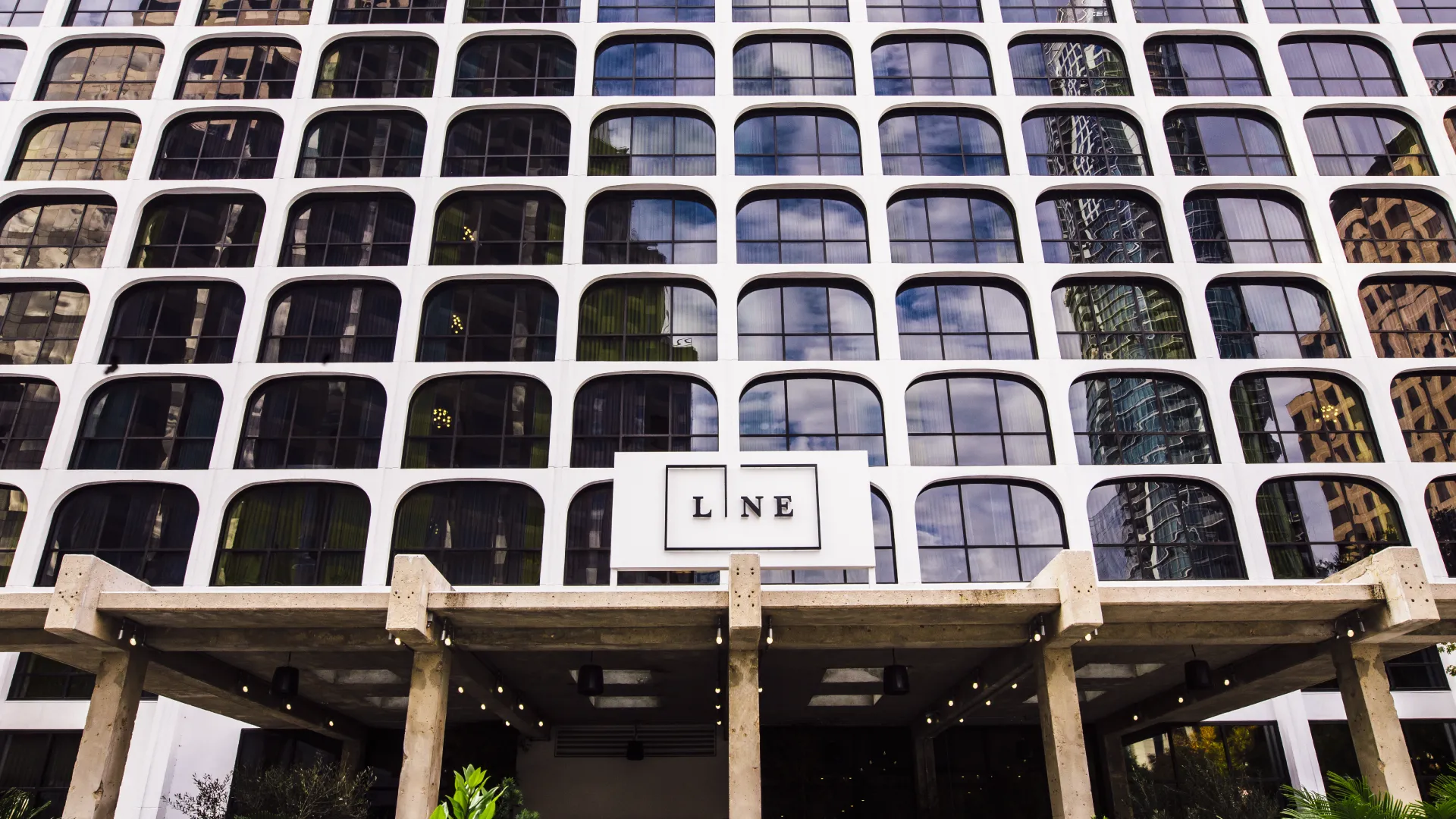
Image credit: The LINE Austin
A Real-World Example: The LINE Austin
A strong hotel rebrand often works best when it listens carefully to the building and the city around it.
The LINE Austin is a useful example. The property transformed the former 1965 Crest Inn, later a Radisson, into a hotel that reconnected the building to its Austin setting.
Image credit: The LINE Austin
Condé Nast Traveler described how the old property had become tired and out of touch with the city’s dining and cultural scene, while the redesign honoured its location through references to local geology, greenery, water, Central Texas art, and Austin’s music culture.
The hotel commissioned more than 500 original works by Central Texas artists and revived cultural programming, including live music, local theatre, sound baths, and an artist-in-residence program.
That is the difference between a refresh and a rebrand.
Image credit: The LINE Austin
A refresh might have made the hotel look newer.
A rebrand made it belong.
How Rebranding Supports Direct Bookings
Rebranding is not only about perception. It also affects how confidently a guest books.
When a hotel’s brand is inconsistent, potential guests have to work harder. They compare photos. They read reviews more nervously. They jump between the website and OTAs. They hesitate.
That hesitation has a cost.
Cloudbeds notes that average commission rates for many major online travel agents now range from 15% to 30% or more, depending on the platform, property, and region. For hotels trying to protect margins, a stronger direct booking presence is not just a marketing concern. It is a business concern.
A rebrand can support direct bookings by making the hotel feel more credible and more desirable at first glance. The website becomes more than a place to check rates. It becomes the beginning of the stay.
The story is clear.
The photography feels aligned.
The room types make sense.
The value is easier to understand.
The guest can imagine themselves there.
That is where confidence begins.
When a Hotel Rebrand Is Worth the Investment
A hotel rebrand is worth considering when the current brand is actively limiting the next stage of the business.
That might mean:
You are preparing for a renovation or reopening.
You want to attract a more aligned guest.
You are repositioning toward a higher ADR.
You are launching a restaurant, spa, event space, or new accommodation type.
You are moving away from generic OTA dependence.
You are expanding into multiple locations or sub-brands.
You are under new ownership or leadership.
You have a beautiful experience that is not coming across online.
The last one is often the most important.
A beautiful hotel can still be misunderstood. A thoughtful stay can still be invisible. A place can have soul and still lack the structure to communicate it.
Rebranding gives that structure form.
Our work with Home One explored a similar challenge in a tourism context: how to create a brand that could speak to individuals and hospitality partners, while still carrying the feeling of quiet, design-led stays rooted in nature. Our work with The Forks also reflects the importance of creating a flexible brand system that can hold multiple touchpoints, spaces, and experiences without flattening what makes each one distinct.
Common Hotel Rebranding Mistakes
A hotel rebrand can lose its way when it becomes too surface-level too quickly.
The most common mistake is starting with aesthetics before strategy. This leads to brands that look polished but feel hollow. The colours may be tasteful. The typography may be modern. But the guest still cannot understand why this hotel, why now, and why them.
Another mistake is forgetting the staff. A hotel brand is not only expressed through signage and websites. It is expressed through the way someone answers the phone, describes the rooms, handles a late arrival, recommends a walk, or explains the story behind the building. If the team is not brought into the rebrand, the guest experience will feel disconnected.
The third mistake is treating launch as an afterthought.
A hotel rebrand needs a rollout plan. Website. OTAs. Google Business Profile. Social channels. Email list. Press outreach. Signage. Printed materials. Staff training. Photography. Internal language. If those pieces do not move together, the rebrand arrives in fragments.
And fragments rarely create trust.
A Little Ghost team member working from a quiet hotel courtyard in Hawaii.
FAQs
What is a hotel rebranding strategy?
A hotel rebranding strategy is the plan that guides how a hotel updates its positioning, messaging, visual identity, guest experience, and launch approach. It helps the property move from an outdated or unclear brand into a more aligned identity that reflects the hotel’s current experience and future direction.
When should a hotel consider rebranding?
A hotel should consider rebranding when the current brand no longer reflects the guest experience, attracts the wrong audience, feels visually dated, creates confusion, or cannot support future growth. Rebranding is especially useful during renovations, new ownership, repositioning, expansion, or the launch of new amenities.
What is included in a hotel rebrand?
A hotel rebrand often includes research, positioning, guest profiles, brand story, messaging, visual identity, art direction, website direction, signage, collateral, OTA updates, launch planning, and brand guidelines. The exact scope depends on the size of the property and how many touchpoints need to be updated.
How long does a hotel rebrand take?
A strategic hotel rebrand can take several months, depending on the size of the hotel and the complexity of the rollout. A smaller boutique property may need a focused strategy and identity process, while a larger hotel with restaurants, events, spa services, or multiple guest experiences may require a deeper phased approach.
How much does it cost to rebrand a hotel?
The cost depends on the size of the property, the depth of strategy, and the number of touchpoints involved. A focused identity refresh may cost less, while a complete hotel rebrand with strategy, messaging, visual identity, website, signage, and launch support requires a more significant investment. We wrote more about this in How Much Does Hotel Branding Cost?.
Ready to Rebrand Your Hotel With More Clarity and Soul?
If your hotel has evolved but your brand has not caught up, Little Ghost can help you find the story, structure, and visual system your next chapter needs.
Book a call with us to talk about where your hotel is going next, and what your brand needs to become to meet it.
Join our mailing list. A short note when we have something worth sharing on brand strategy, identity thinking, and field reflections from the places shaping our work.
Thank you! Your submission has been received!
Oops! Something went wrong while submitting the form.